


TL;DR: A Google Ads agency should deliver an account you own, conversion tracking that matches your real sales, brand searches kept apart from new customers, targets set from your margin, and a report that says what changed and what’s next. Clicks, badges and optimisation scores are not deliverables. In 10 accounts we took over, 7 had tracking that was missing, broken or not trusted.
When we take over a Google Ads account, the first week is mostly working out what’s already there. Who set it up, what it’s counting as a conversion, and why it’s bidding on searches the business doesn’t want. After enough takeovers, the same problems kept coming up. So we wrote them down, and turned them into the checks we’d want any brand to run on its agency, including us.
Who’s talking
Almas Tariq is an SEO Specialist & Copywriter at Vonnimedia with six years in digital marketing. She leads SEO for Australian brands, covering technical, on-page, local and content SEO, with a focus on blog authority and AI search visibility.
Veronica Cremen is the founder of Vonnimedia, a Sydney performance marketing agency. The data in this article comes from accounts and sales records her team manages.
Table of contents
- What a Google Ads agency should deliver: the short answer
- What we found in 10 Google Ads accounts we took over
- The 8 things to check
- What isn’t a deliverable
- What Google requires, and what’s best practice
- Where we’ve got it wrong
- So, what should your Google Ads agency deliver?
- FAQs
What a Google Ads agency should deliver: the short answer
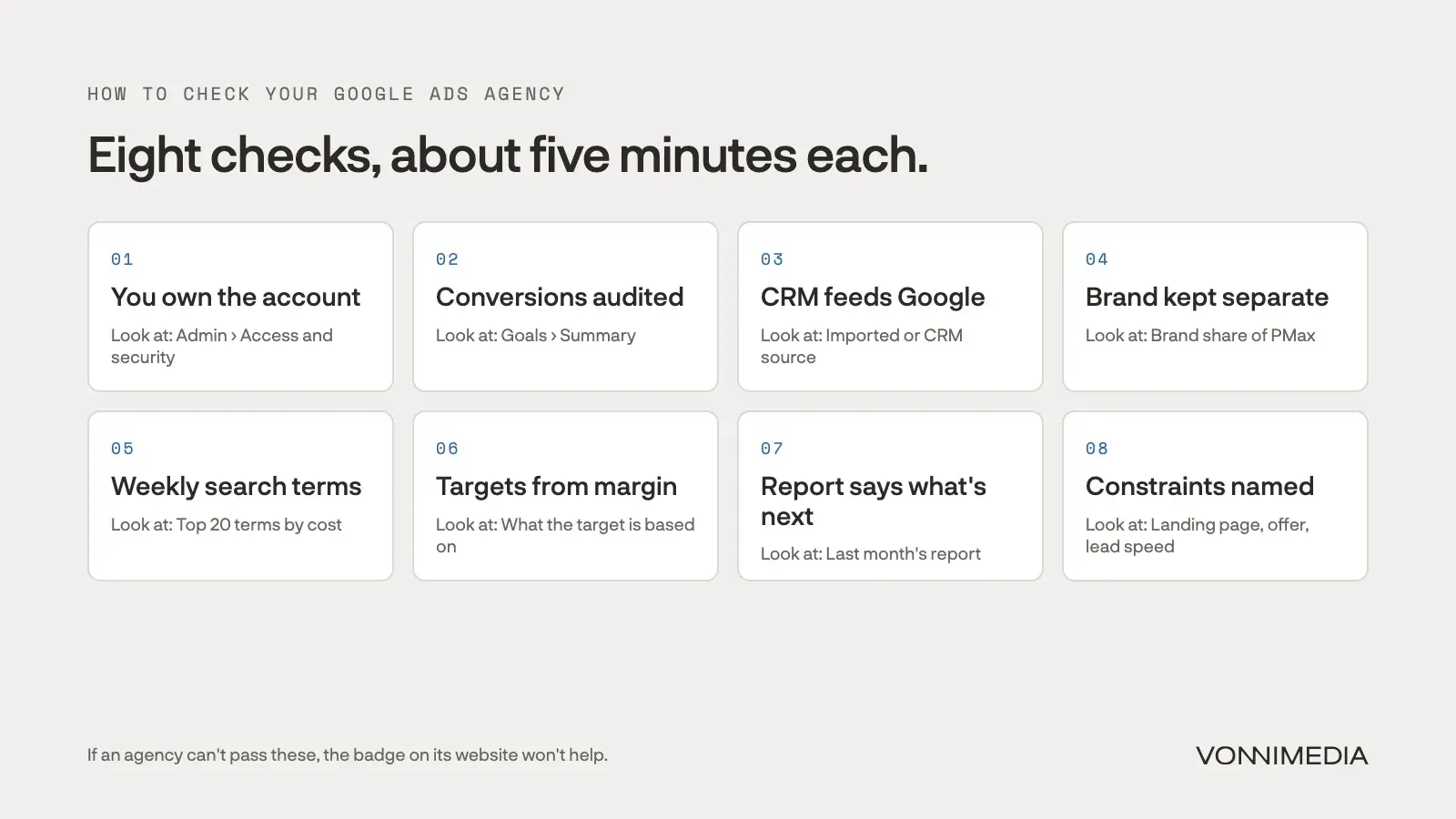
Eight things. Each one can be checked in about five minutes.
- An account you own, and written terms for leaving.
- A conversion list someone has audited.
- Your CRM feeding qualified and closed leads back to Google.
- Brand searches kept apart from new demand.
- Search terms and negative keywords managed every week.
- Targets set from your margin, with a review date.
- A report that says what changed, why, and what’s next.
- The truth about what’s holding results back outside the ad account.
What we found in 10 Google Ads accounts we took over
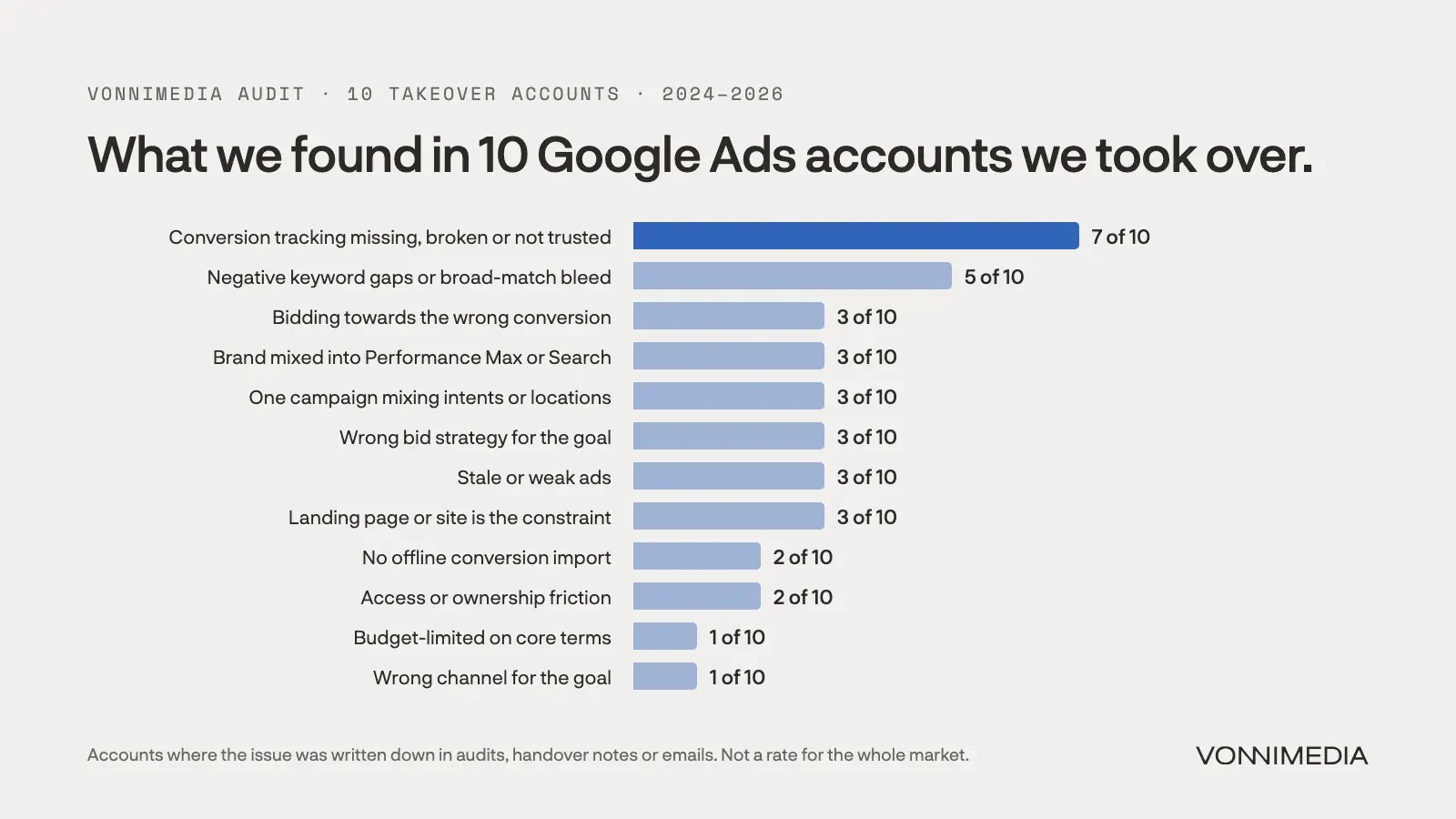
We went back through audits, handover notes and emails for 10 Google Ads accounts we inherited from other agencies or in-house teams between 2024 and 2026. They span ecommerce, travel retail, financial education, construction, automotive, surveying and leisure. The counts below are accounts where the issue was written down, not a rate for the whole market.
| Issue | Accounts (of 10) |
|---|---|
| Conversion tracking missing, broken or not trusted | 7 |
| Negative keyword gaps or broad-match bleed | 5 |
| Bidding towards the wrong conversion | 3 |
| Brand mixed into Performance Max or Search | 3 |
| One campaign mixing intents or locations | 3 |
| Wrong bid strategy for the goal | 3 |
| Stale or weak ads | 3 |
| Landing page or site is the constraint | 3 |
| No offline conversion import | 2 |
| Access or ownership friction | 2 |
| Budget-limited on core terms | 1 |
| Wrong channel for the goal | 1 |
Some of what we expected to find didn’t show up. We found no case of tracking set up under the previous agency’s own login, no documented Search Partner waste, and no damage from auto-applied recommendations. So we haven’t claimed them.
The 8 things to check
1. You own the account, and you know how to leave
Expect the account to sit under your business and run on your card, with the agency given access through its own manager account. Expect written exit terms too: notice period, a handover meeting and an export of your performance history.
How to check it: go to Admin, then Access and security, and make sure someone at your company is an admin. Ask for your customer ID. Google’s third-party policy says agencies must give it to you on request.
What we found: 2 of 10 had access problems. In one, admin rights sat on a former staff member’s email, and the client had to go through Google to remove them.
2. Your conversion list has been audited
Google’s bidding works towards whatever is set as a primary conversion. Expect every conversion action to be listed, with a reason why each primary one is primary, and duplicates and micro-events like page views set to secondary.
How to check it: open Goals, then Summary. Count the primary actions. Then compare last month’s reported purchases or leads with your real orders or CRM.
What we found: in 3 of 10 accounts, bidding chased the wrong event. One travel retailer had five purchase actions set as primary, and the only one recording real purchases was set to secondary. A financial education business had 50 conversion actions. We cut it to 8, and cost per lead on its flagship course fell 55%.
3. Your CRM tells Google which leads were real
If you sell on leads, Google only knows what a form fill looks like unless you tell it more. Expect enhanced conversions for leads or offline conversion import, so qualified and closed leads go back to Google. Expect consent mode set up if you have traffic from the EEA or UK.
How to check it: look for an imported or CRM source in your conversions list. If you sell B2B and there isn’t one, Google is optimising for form fills.
What we found: 2 of 10 had no offline import at takeover. For a construction business, we scoped a CRM sync from scratch.
4. Brand searches are kept apart from new demand
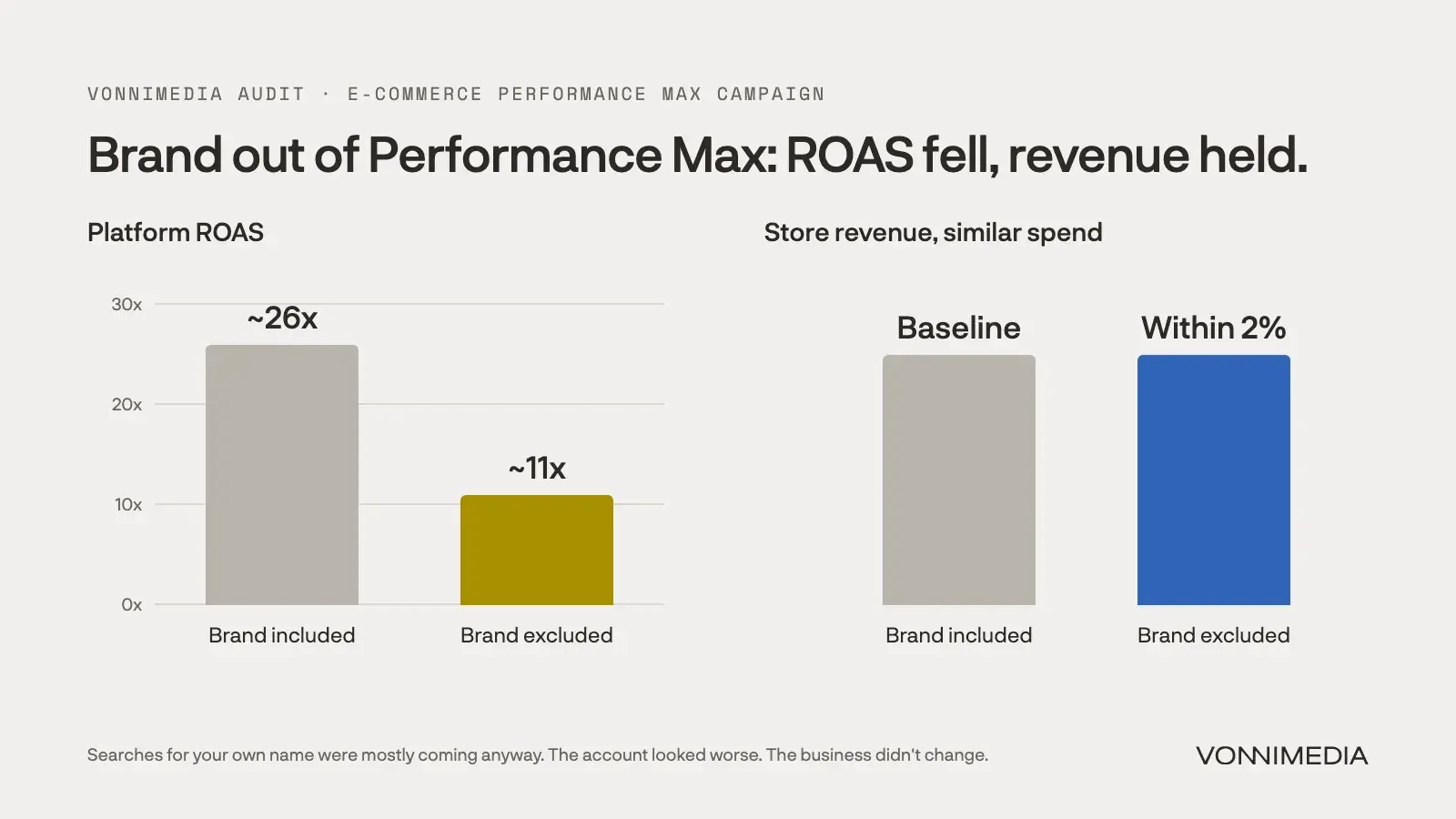
People who search your name were probably coming anyway. If those searches sit inside Performance Max, return on ad spend looks better than the new business it’s bringing in. Expect brand in its own campaign, Performance Max brand exclusions used on purpose, and your store or CRM revenue reported next to platform ROAS.
How to check it: ask what share of Performance Max conversions came from searches for your own name. If nobody can tell you, the ROAS is unproven.
What we found: 3 of 10 mixed brand into Performance Max or Search. When we took brand out of one ecommerce Performance Max campaign, its ROAS fell from about 26 to about 11, while store revenue held within 2% at similar spend. The account looked worse. The business didn’t change.
5. Search terms and negatives are managed every week
Expect a weekly search term review, a structured negative keyword list, and campaigns split by intent and location so services and sites don’t bid against each other.
How to check it: open the search terms report for the last 30 days and sort by cost. Are the top 20 terms things you sell?
What we found: 5 of 10 had negative gaps or broad-match bleed, including competitor brand searches spending with zero conversions. 3 of 10 ran different services or locations in one campaign. We build negatives in seven groups: competitors, irrelevant themes, informational searches, wrong products, bargain seekers, marketplaces and job seekers.
6. Targets come from your margin
Expect your cost per acquisition or ROAS target to be worked back from what a customer is worth to you after costs. Expect a date the target was last reviewed, and a learning budget for every new campaign.
How to check it: ask what your target is based on. Since 17 August 2026, budget-limited target CPA and target ROAS campaigns deliver to the target you set rather than beating it, so a stale target now costs you volume. Our own modelling showed up to 50% less volume for the same spend in the worst case.
7. The report says what changed, why, and what’s next
Google’s policy sets the minimum: monthly cost, clicks and impressions, Google’s exact cost without fees, and fees disclosed in writing. A useful report goes further: what changed, why, what the agency will do next, what it needs from you, and your real revenue or qualified leads next to Google’s numbers.
How to check it: read last month’s report. Can you tell what the agency will do differently this month? If not, it’s a data export.
8. They tell you what’s outside the account
Expect the agency to name the constraint even when it isn’t in their scope: the landing page, the offer, how fast leads get a call back, or whether Google Ads is the right channel at all.
What we found: 3 of 10 were held back by the site, with homepage-only landing, no reviews or guarantees, or slow lead routing. In one, the previous agency had been running YouTube awareness for a business that needed high-intent search.
Want us to run the eight checks on your account? A senior strategist will go through your Google Ads account against all eight and tell you what’s holding results back. Book a call.
What isn’t a deliverable
- A Partner badge. Partner status needs a 70% optimisation score, USD $10,000 of spend over 90 days and half the strategists certified. The score rises when recommendations are applied or dismissed. Google calls it an estimate and doesn’t say it tracks results.
- A guarantee. Two of the three top-ranking service pages lead with money-back or work-for-free promises. Ask what the guarantee is measured on. If it’s Google’s own conversion count, see check 2.
- Activity. Number of changes made isn’t progress. New campaigns need time on stable settings before Smart Bidding can learn.
- ROAS on its own. ROAS that includes your own brand searches mostly counts customers who were already coming.
What Google requires, and what’s best practice
| Topic | Google’s position | Status |
|---|---|---|
| Reporting | Monthly cost, clicks and impressions. Google costs shown exactly, without fees | Policy |
| Fees | Disclosed in writing before the first purchase and on every invoice | Policy |
| Customer IDs | Given to the advertiser on request | Policy |
| Separate accounts | One account per advertiser | Policy |
| Admin ownership | Not required by Google | Best practice |
| Optimisation score | An estimate, reaches 100% by applying or dismissing recommendations | Not a result |
| Auto-apply | Off by default, history visible in the account | Check it |
| Target bidding | Budget-limited tCPA and tROAS deliver to target from 17 Aug 2026 | Changed |
Where we’ve got it wrong
We’ve lost performance history on older accounts when access moved after a client left. Exit terms and a history export are now part of how we start.
Our own automated monthly report is data only. The commentary happens in the monthly meeting. We’re adding it to the report.
And when we took brand out of Performance Max for a client, we didn’t explain the trade-off well enough. The account looked worse, the brand negatives were removed, and they had to be put back. The number was right. The conversation came too late.
So, what should your Google Ads agency deliver?
An account you own, conversions that match real sales, brand kept separate, targets from your margin, and a report that tells you what’s next. Run the eight checks. If an agency can’t pass them, the badge on its website won’t help.
That’s the standard we hold our own Google Ads management to. If you run both channels, read why Meta ads are costing more too.
Ready to talk? Book a call with a senior strategist to run the eight checks on your account.
Work with Vonnimedia
Ready to put this into practice?
Our team works with Australian brands to implement the strategies covered in this article. Get in touch to talk about your goals.